
Roofing
Roofing Dumpster Rental in Brandon
Tear-off containers sized by the square and by the material, set where the crew is actually working. Shingles are heavy, tile is heavier, and in the summer rainy season an open box turns into a swimming pool overnight. Water is weight you pay to haul.
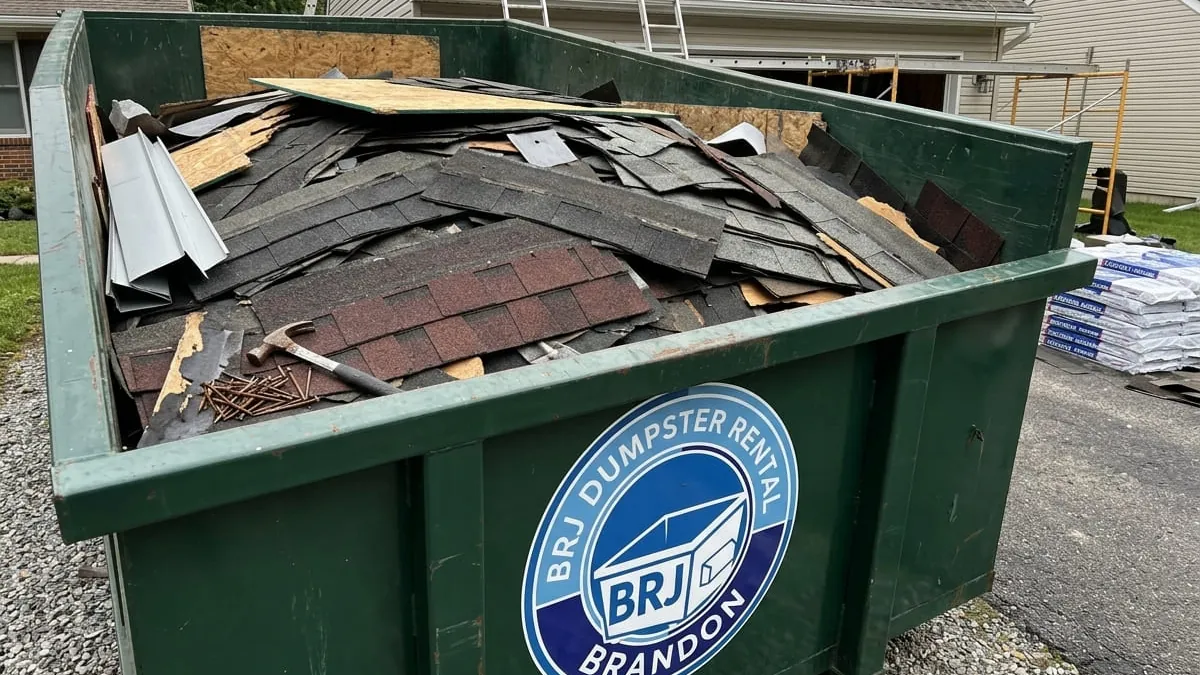
A roofing container is sized by weight, not by how big the pile looks from the driveway. Roofing is the densest ordinary debris a house produces. A square of architectural shingle is heavy on its own, a layer of old three-tab underneath it doubles the figure, and the felt, drip edge and nails add more than people expect. Concrete or clay tile, which is common enough on Brandon houses of a certain age and on every Mediterranean-styled elevation built since, is heavier again by a wide margin. That is why a roofing box is usually short and why it looks wrong when it goes out. A 15 yard on a mid-sized tear-off will often be loaded barely past halfway and still be at a lawful payload. That is the container behaving correctly. Tell us the squares, the number of layers and whether it is shingle or tile at booking, and we will bring the box that can actually leave your driveway when it is full.
The second thing that decides a roofing job here is the season. Brandon sits under a summer convective rainy season, roughly June through September, when something like thirty inches of rain falls in a pattern of near-daily afternoon storms. The National Weather Service office for this area is NWS Tampa Bay Area at Ruskin. What that does to a tear-off is straightforward and expensive: an open container standing overnight in August collects water, torn-off shingles and felt soak it up and hold it, and water is weight the customer pays to haul. A load that would have gone out at a comfortable payload on a dry Tuesday can be over it by Thursday without a single extra shingle. So the tarp is not optional here, and neither is the collection timing. Strip in stages, keep the box covered between sessions, and call for pickup as soon as the deck is clear.
Placement on a Brandon roof job is easier than in most markets and worth setting up properly. These are flat lots and flat driveways, mostly single-story or two-story slab houses with generous concrete out front, so the container can usually go tight to the eave on the side the crew is working. That is the whole point: every foot between the ladder and the rim is a foot somebody carries a shovel load. We set the box square to the run of the roof rather than square to the house, lay plywood under the wheels and the rails, and put a ground tarp down along the drip line so the nails and granules that miss come up with a magnet instead of into a tire. What we will not do is set the box on the lawn. The soil here is Myakka fine sand, rated very poorly to poorly drained, and in the wet months the water table sits under 18 inches. A loaded roofing box on wet sand ruts and stays rutted.
There is one placement myth worth correcting because roofers hear it constantly. National dumpster blogs will tell you to keep the container ten feet from the building. That figure comes from the International Fire Code, and Florida does not use the International Fire Code. Florida works from NFPA 1, adopted as the Florida Fire Prevention Code, 8th Edition, effective 31 December 2023, under § 633.202, Fla. Stat., with NFPA 1 (2021 edition) as the base document. The relevant chapter is Chapter 19, Combustible Waste and Refuse, and 19.1.2 states that combustible waste cannot be allowed to build up inside or outside the building in any manner that will pose a fire hazard. That is a performance requirement about accumulation rather than a tape measure. In practice we keep containers clear of the eaves, the electrical meter and the AC condenser as a matter of craft, and on a tear-off the box goes where the crew can reach it.
Storm work is its own category in this town, and Brandon’s position inland changes the shape of it. Tampa Bay is one of the most surge-prone metros in the country, but Brandon is not on the water. What reaches here is wind, rain and tornado. Hurricane Helene made landfall about 150 miles away and still pushed water 7.2 feet above mean higher high water at East Bay Tampa, which was a coastal event. Hurricane Milton came ashore far closer and produced only one to two feet of surge inside Tampa Bay because the winds blew offshore, but it brought record Hillsborough River crests, 20.40 inches of rain and 45 tornadoes. For a Brandon roof that means the damage arrives as lifted shingles, missing ridge, torn fascia and water intrusion rather than as flooding. It also means the whole street needs a roofer at once. Call early and we will get a box on the drive. See storm debris cleanup.
Roofing Work We Size Containers For
Single-Layer Asphalt Tear-Off
The common Brandon job. Architectural or three-tab shingle, felt, drip edge and nails off a one-story ranch. Sized by the square and loaded flat so the weight sits across the whole floor of the box.
Multi-Layer Tear-Off
Where a second roof went on over the first. Two layers roughly doubles the weight for the same roof area, which moves the sizing conversation down a box rather than up one.
Concrete And Clay Tile Removal
Far heavier per square than shingle and it does not compress. Tile goes in a 10 yard loaded flat and low, in pieces two people can place, and it should not ride with light material.
Metal Roof Replacement
Panels, ridge, trim and fasteners. Light for the volume and awkward to stack, so it wants a bigger box than the weight suggests and careful loading so nothing sits proud of the rim.
Flat And Low-Slope Sections
Modified bitumen, torch-down and old built-up material off an addition or a carport. Dense, sticky and heavy when wet, and it soaks up rain faster than anything else on the roof.
Decking Replacement
Rotted plywood or board decking coming off with the roof. Wet decking weighs far more than dry, and on a 1970s house there is usually more of it than the estimate allowed for.
Storm Repair And Partial Reroof
Lifted shingle fields, missing ridge, torn fascia and soffit after a blow. Often a whole street at once, which is why the container needs to be booked before the crew is.
Lanai And Carport Roof Panels
Aluminum and fiberglass panels, screen frame and the fastener strip. Very light, very bulky, and it should not be the reason a heavy roofing box gets ordered a size larger.
Sizing A Roofing Container
Count squares and layers before anything else. As a working rule, a 10 yard suits a small tear-off, a single slope or any tile job, because tile reaches payload while the box still looks nearly empty. A 15 yard is the standard single-layer asphalt tear-off box on an ordinary Brandon ranch and it is the size we bring most often. A 20 yard covers a larger roof, a multi-layer strip on a modest footprint, or a reroof where the decking is coming off too. Above that, size stops being about volume and starts being about the truck, because a container full of roofing hits weight long before it hits the rim. Keep tile out of the shingle box and keep the lanai panels out of both, because a mixed load attracts a surcharge of twice the posted rate at the county scale. Full dimensions are on the container sizes page and the tear-off size guide works through the math.
10 Yard Dumpster
Concrete, block, roof tile and wet debris — and more than the County’s whole free yearly bulky allowance.
View this size →15yd³15 Yard Dumpster
A single room, a small tear-off, or a two-car garage cleared to the walls.
View this size →20yd³20 Yard Dumpster
A whole-house declutter — the Brandon default — or a multi-room remodel.
View this size →Setting The Box, Tarping It And The Fire Code
We set a roofing container tight to the work, on concrete, with plywood under the wheels and the rails and a ground tarp along the drip line for the nails and granules. The truck wants roughly 60 feet of straight run, about ten and a half feet of width and 20 feet or more of overhead clearance for the hoist, and on these lots the thing to watch overhead is a live oak limb or the service drop. Grass is out. Myakka fine sand is very poorly to poorly drained with a water table under 18 inches for one to four months in most years, and a loaded roofing box is several tons on a small footprint. The tarp matters as much as the boards. Roughly thirty inches of rain falls across June to September in near-daily afternoon storms, and shingles hold water. Keep it covered between sessions and call for collection the day the deck is clear. On placement rules, Florida uses NFPA 1 rather than the International Fire Code, so the ten-feet line from national blogs is not the rule here. NFPA 1 Chapter 19 requires that combustible waste not accumulate in a way that poses a fire hazard, and we place containers clear of the house, the eaves, the meter and the condenser as a matter of practice.
Not sure this is the right service? Describe the job on the phone and we will point you at the right container even if it is a different service page. Call (813) 773-2486.
Get a flat quote
Two minutes on the phone gets you a size, a price and a delivery slot. No forms.
(813) 773-2486Recommended sizes
How it works
Roofing Dumpster Rental in four steps
- 1
Call us
Tell us the project, your address and when you want it. Two minutes on the phone and you have a flat price.
- 2
We deliver
Our driver walks the drop, lays protection boards and sets the container exactly where you want it.
- 3
You load it
Take your time within your rental window. Keep it level with the top rail and we handle the rest.
- 4
We haul it
Call or text when you are done. We pull it, sort what can be recovered and dispose of the rest properly.
Roofing Dumpster Rental FAQs
What size do I need for a tear-off?
Give us squares and layers and we will give you a box. A single layer of asphalt off an ordinary Brandon ranch is usually a 15 yard. Two layers over the same roof area moves you down to a smaller box loaded flat, not up to a bigger one, because the limit is weight. Tile is its own category: concrete and clay tile are heavy enough that a 10 yard loaded low is the honest answer even on a modest roof. If the decking is coming off as well, add for that, and remember wet decking weighs far more than dry. Call the yard on (813) 773-2486 and describe the roof rather than guessing from a chart.
Why does the container look half empty when you take it away?
Because roofing reaches a lawful payload long before it reaches the rim. Shingle, felt and nails are dense, tile more so, and a truck has a legal weight it can carry down Lumsden Road like anybody else. A box loaded flat and level to somewhere around half its depth is a full load of roofing. Filling it to the top would give you a container that cannot lawfully leave the driveway, which costs everyone a morning and solves nothing. Load across the whole floor rather than heaping at the door end, keep the material below the fill line, and let the box go when it is at weight.
Does rain really matter that much?
It matters more here than almost anywhere. Brandon is in a summer convective rainy season from about June through September, with roughly thirty inches of rain falling in near-daily afternoon storms according to the local climate record kept by NWS Tampa Bay at Ruskin. Torn-off shingles and felt absorb water and hold it, so an open container standing overnight in August is heavier in the morning for no extra material. Water is weight you pay to haul. Tarp it between sessions, tarp it overnight, and get it collected as soon as the deck is clear rather than letting it stand through a wet week.
How close to the house can the container sit?
Close enough that the crew is not walking shovel loads across the yard. The rule you may have read, that a container has to be ten feet from the building, comes from the International Fire Code, and Florida does not use the International Fire Code. Florida adopts NFPA 1 as the Florida Fire Prevention Code, 8th Edition, effective 31 December 2023, under § 633.202, Fla. Stat., with the 2021 edition of NFPA 1 as the base document. Chapter 19 covers combustible waste and refuse and requires that it not build up in a way that poses a fire hazard. We keep the box clear of the eaves, the meter and the AC condenser and set it where the ladder is.
Can the old roof go out with the county collection?
No. Hillsborough County does not collect construction and demolition debris, and a tear-off is squarely that. The curbside bulky program is for household goods, priced by the item at roughly $30 to $50, and the Community Collection Centers give a household 10 cubic yards of bulky waste a year free, self-unloaded by hand, with no dump trailers allowed. Neither route is open to a roof. A container is the route that is left, and on a tear-off it is also the only sensible one, because the material comes off faster than any vehicle you own could carry it away. See Florida disposal rules for the rest.
More services
Other things we haul
Residential Dumpster Rental
Driveway placement for the garage, lanai and shed cleanouts a slab-built house produces.
Learn more →Commercial Dumpster Rental
Containers for businesses and contractors — the County does not collect construction debris.
Learn more →Construction Dumpster Rental
Mixed C&D in one roll-off, with next-day swap-outs across Hillsborough County.
Learn more →Roll-Off Dumpster Rental
10, 15, 20, 30 and 40 yard roll-offs across Brandon and Hillsborough County.
Learn more →Same-Day Dumpster Rental
Call before the cut-off and we can usually get a container to you this afternoon.
Learn more →Junk Removal Dumpsters
Clear a garage, lanai, shed or spare room on your own schedule.
Learn more →Estate Cleanout Dumpsters
Discreet, patient container service for families clearing a lifelong home.
Learn more →Demolition Debris Removal
Containers and fast swaps for lanais, decks, sheds, garages and interior gut-outs.
Learn more →Concrete & Heavy Debris
Dedicated heavy cans for concrete, block, roof tile and rubble on sandy ground.
Learn more →Yard Waste & Brush Removal
Clean separate loads for palm fronds, oak limbs and clearance beyond the curbside limit.
Learn more →Where we deliver
Roofing Dumpster Rental across Hillsborough County and the Tampa Bay area
Same service, same flat rates, every town below. Pick yours for local placement and permit notes.
Talk to a real person
Need roofing dumpster rental in Brandon?
Tell us what you are clearing out and we will tell you the right size and the flat price to put it in your driveway. No forms, no waiting on an email — just call and we will sort it out in a couple of minutes.
Serving Brandon, Hillsborough County and the Tampa Bay area · Mon–Fri 6:30am–5pm, Sat 7am–1pm