
Sizes
What Size Dumpster Do I Need in Brandon, FL? A Sizing Guide
The 20 yard fits most Brandon jobs, and the reason is the housing stock. Here is how to size a container for a 1970s slab house, why the 10 is the heavy box, and what the county will not collect.
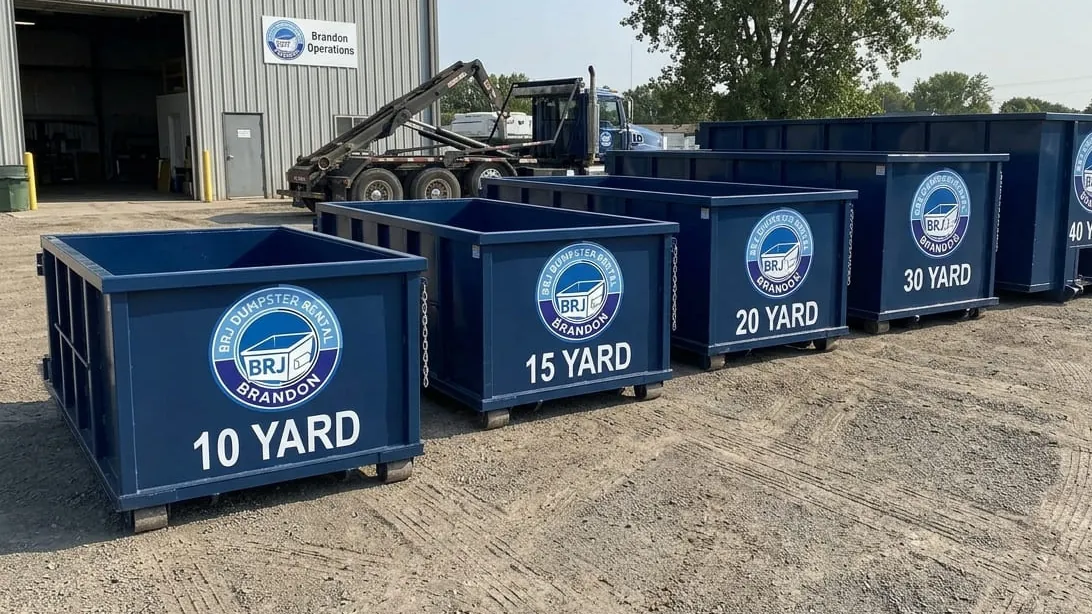
Almost every call starts the same way. Someone is standing in a garage in Brandon looking at forty years of accumulation, and they want to know which box to put in the driveway. The honest answer is that the size question is really two questions. How much room does the debris take up, and how much does it weigh. Get those backwards and you either pay to haul air or you overload a container that cannot legally leave your property.
Here is how we size jobs in Brandon and the rest of unincorporated Hillsborough County, and why the answer here is not the same as the answer in a market with a different housing stock.
The 20–yard is the Brandon default
If you called and told us nothing except your address and the word “cleanout,” we would put a 20 on the truck. It is the size that fits the most common Brandon job, and the reason is the housing.
Brandon went from 12,749 people in 1970 to 41,826 in 1980. That is a 228 percent decade. The town arrived almost all at once, filled in through the 1990s and 2000s, and then essentially stopped growing — only about 11 percent through the 2010s, reaching 114,626 in 2020. The growth moved on. The houses stayed.
A house built in that boom is now forty to fifty-plus years old. It is on its second or third roof, its first or second kitchen, and its original windows are coming out. That is a renovation and cleanout market, and the 20–yard is the container that matches it: a multi-room remodel, a whole-house declutter, a garage and lanai purge done in one weekend rather than three.
Drive ten minutes south to Riverview and the math changes completely. Riverview grew 490.4 percent between 2000 and 2010. Those houses are still under their original finishes. Two housing vintages thirty years apart, sitting side by side in the same county. Same truck, different job.
What a Brandon house actually gives you to throw away
Houses here sit on a slab. There is no below-grade storage and no attic worth the name. Everything a family accumulates ends up in three places, and those three places are the job.
The garage
Two cars wide, one car used. Paint cans, patio furniture with rusted-through legs, a chest freezer that stopped working during a storm, boxes of paperwork, half a screen enclosure. Garages are volume, not weight. They fill a container faster than people expect and weigh less than people fear.
The lanai and the screen enclosure
Screen frame, torn panels, old pavers, a hot tub surround, planters full of dirt. Mixed volume and weight. Dirt and pavers are the part that will surprise you on the scale.
The shed and the side yard
Yard tools, fence panels, pressure-treated lumber, bags of hardened concrete mix. This is where a load quietly gets heavy.
The five sizes, and what each one really holds
| Size | Rough footprint | What it actually suits in Brandon |
|---|---|---|
| 10 yard | Shortest box, fits a single-car driveway | The weight box. Concrete, block, roof tile, pavers, dirt, wet debris |
| 15 yard | Still driveway friendly | One room gutted, a small tear-off, a garage clear-out |
| 20 yard | Standard driveway length | The default. Whole-house declutter, multi-room remodel, garage plus lanai |
| 30 yard | Needs a long driveway or a lot | Large remodel, full estate cleanout, bulky furniture volume |
| 40 yard | Needs the most room and overhead clearance | Commercial and construction jobs, light bulky debris in quantity |
The full breakdown of dimensions and clearances lives on our dumpster sizes page. Use it for the tape-measure decision, and use this article for the judgment call.
The 10–yard is not the small one. It is the heavy one.
This is the single most useful thing to understand about container sizing anywhere, and people get it wrong constantly. The 10 is not for small jobs. It is for dense jobs.
Concrete, brick, block, roof tile, pavers, dirt and sod are all heavier per cubic yard than anything else you will throw away. A 10–yard box filled with broken driveway will hit a truck weight limit long before it looks full. If you put that same material in a 20, you will have a container we cannot legally lift.
So the rule is simple. If the debris is mostly inert and mineral, you want the 10 and you want it loaded flat and low. If the debris is household volume, you want the 20. If it is a mix, call and describe it — that is a two-minute conversation and it is free.
Worth noting what a single 10 represents locally. Hillsborough County’s Community Collection Centers give a household 10 cubic yards of bulky waste per year free of charge. One 10–yard container is more than the county’s entire annual allowance, delivered to your driveway, in one afternoon.
The county’s own numbers, and why they favor a container
Brandon is an unincorporated community. There is no City of Brandon, no mayor and no city hall — Hillsborough County is the government here, and the county publishes exactly what it will and will not do with your discards. Those published numbers make the sizing decision for a lot of people.
- Bulky curbside pickup is priced per item, in a published range of about $30 to $50 each — confirm current figures with the county, because published rates get revised. Furniture, mattresses and televisions under 50 inches sit at the lower end; refrigerators, washers, dryers and ovens sit at the upper end. Ten items adds up fast, and you still have to schedule it.
- The free Community Collection Center bulky allowance is 10 cubic yards per year. A single kitchen demolition uses all of it.
- “Bulky waste must be self-unloaded by hand. No dump trailers allowed.” That is the county’s wording. You cannot back a trailer in and tip it. You lift every piece, twice.
- Yard waste at the curb is capped at 2 cubic yards a week, rising to 3 cubic yards a week from February through April. Branches under four feet long and six inches thick, and no container over 50 pounds.
- The county does not collect construction and demolition debris. Renovation debris is not a curbside category at all.
The county publishes all of this on hcfl.gov. Check it against your own job before you decide. What it usually shows is that the container is not competing with “free” — it is competing with per-item fees, an annual cap and a lot of hand-lifting.
One more piece of local arithmetic worth having in your head. Because Hillsborough funds residential solid waste through an assessment on the property tax bill rather than a monthly utility charge, plenty of homeowners assume disposal is already paid for. It is, for ordinary household garbage, recycling and yard waste inside the published limits. It is not for renovation debris, it is not for contractor-generated material, and it is not for anything past the annual self-haul allowances. That gap is exactly where a container earns its keep, and it catches people off guard here more than it does elsewhere.
The other thing that shifts the size decision is access. A 30 or a 40 needs length and overhead clearance, and a lot of Brandon driveways from the boom years are short, with a mature oak or a laurel over them. If the driveway will only take a 20, take the 20 and plan a swap rather than forcing a bigger box into a spot that cannot hold it. A swap on a container that fits costs less than a scraped roofline or a broken limb.
Sizing by the job in front of you
Kitchen gut, single family
Cabinets, counters, appliances, flooring, drywall. Call it a 20 unless you are also taking up tile set in mortar, in which case split the load: inert material in a 10, everything else in the 20.
Bathroom remodel
A 10 or a 15. Old tile, a cast iron tub and a mortar bed are heavy out of proportion to their volume. This is a weight job disguised as a small job.
Whole-house declutter
A 20 for most Brandon houses, a 30 if the original owners lived there thirty years and nothing ever left. Furniture is bulky and light, which is the profile the bigger boxes are built for.
Garage and lanai together
A 20 handles it comfortably. If the screen enclosure frame is coming out too, you will use the space.
Roof tear-off
Its own calculation entirely, and shingles are far heavier than they look. We wrote that one up separately — see our roofing container service for how squares translate into tons.
Water is weight, and here it rains for four months
Roughly two-thirds of the year’s rain in this part of Florida falls between June and September, in near-daily afternoon convection. An open-top container sitting in a driveway through that is collecting water, and water is weight you pay to haul.
Wet drywall, wet carpet, wet cardboard and wet insulation gain enormous weight. The practical answers are boring and they work: load the heavy inert material low and flat, keep absorbent material covered or scheduled tight, and do not let a full box sit through a wet week waiting for a swap. If your job runs through the rainy season, ask about a tarp when you book. Same phone number: (813) 773-2486.
Where the box sits matters as much as which box it is
The ground under Brandon is Myakka fine sand — Florida’s official state soil since 1989, formed in sandy marine deposits and classed by the USDA as very poorly to poorly drained. Its water table sits less than 18 inches down for one to four months in most years, and that window lines up with the summer rainy season.
A loaded 20–yard container weighs several tons on a small number of contact points. On saturated sand, a lawn or an unpaved verge is not a load-bearing surface, no matter how firm it feels in April. Sand drains fast and loses cohesion just as fast. Wheels cut in, and then you have two problems.
So: driveway, not grass. Plywood or planks under the rails and the wheels to spread the load and protect the concrete. Clear of the eave line, the meter and the air conditioning condenser. Thirty seconds of thought at delivery beats a rut and a repair bill.
When to go one size up
Three situations, consistently:
- You are guessing. The difference in price between a 15 and a 20 is small. The cost of a second haul because the first box filled is not.
- The job has furniture in it. Furniture is deceptive volume. Sofas, mattresses and patio sets stack badly and waste a third of a box.
- More than one trade is working. Once a second crew starts putting material in, capacity disappears faster than anyone plans for.
And one situation where you should go down a size: anything mineral and dense. Concrete, block, tile, dirt, pavers. Smaller box, flat load, no exceptions.
If you would rather just describe the job to somebody who has hauled it before, call BRJ Dumpster Rental Brandon at (813) 773-2486. We have been running Brandon out of Parsons Avenue since 2013, and sizing a job over the phone takes about two minutes.
Questions this guide did not answer? Call (813) 773-2486. We would rather spend two minutes on the phone than have you order the wrong container.